7 Automatic Fails on the Nova Scotia Road Test (Avoid These Mistakes)
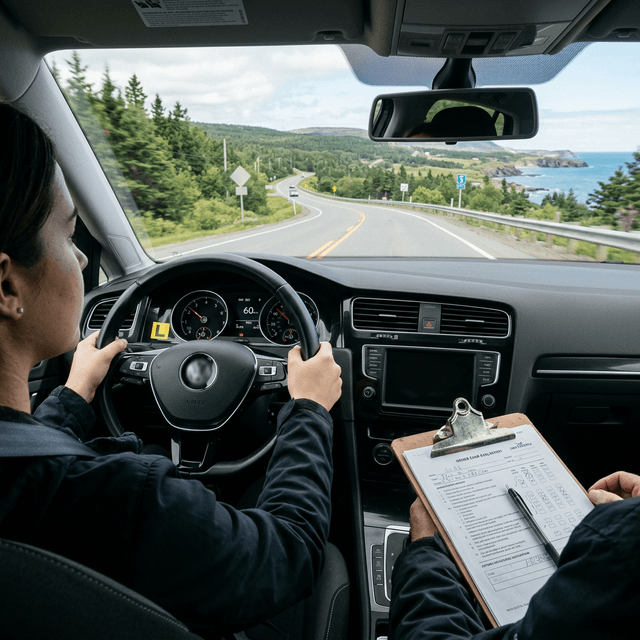
Your road test isn't about being a perfect driver. It's about proving you're a safe one. But certain mistakes don't just lose you points—they end your test immediately. If you are wondering what fails you on a driving test, you need to understand the difference between a simple deduction and a critical error.
For many new drivers, the anxiety leading up to test day is overwhelming. You have spent months practicing, taking in-car lessons, and studying the handbook. You feel ready. But under the pressure of the examination, even confident drivers can make uncharacteristic mistakes. You may have the skills to drive safely, but if you commit one of these specific driving errors, the examiner has no choice but to mark your sheet with an automatic fail.
Here are the 7 critical errors that result in an automatic fail road test nova scotia. Know them, understand why they happen, and learn exactly how to avoid them so you can pass on your first attempt.
How the Nova Scotia Road Test Scoring Works
Before we dive into the specific road test mistakes nova scotia examiners watch for, it is crucial to understand how the evaluation is structured.
The standard Class 5 road test in Nova Scotia takes approximately 20 to 30 minutes, depending on the route and traffic conditions. During this time, the examiner uses a standardized scoring sheet to evaluate your performance across a variety of categories, including observation, speed control, steering, right-of-way judgment, and specific maneuvers like parking and backing up.
Point Deductions vs. Automatic (Critical) Fails
The scoring system is fundamentally based on deductions. You start the test with a perfect score. As you drive, if you make a minor error—like signaling a little too late, or taking a corner slightly too wide—the examiner will deduct points.
You are allowed to make minor mistakes. You can accumulate several minor deductions and still pass the test, provided your overall score remains above the passing threshold and you demonstrate general competence and safety.
However, there is a separate category of errors known as critical errors or automatic fails. If you commit just one of these errors, your point total no longer matters. The test is effectively over. In some severe cases, the examiner may even direct you to take the shortest route back to the testing center or ask to take over driving.
You can make small mistakes and still pass — but these 7 are instant game over.
The 7 Automatic Fails
1. The Examiner Has to Intervene
What it is: During the road test, if you get into a situation where the examiner feels compelled to physically intervene to prevent a collision or a dangerous situation, you will fail instantly. This includes the examiner grabbing the steering wheel, using the dual-brake (if you are in a driving school vehicle), or forcefully verbally commanding you to stop ("STOP NOW!").
Why it's an instant fail: The examiner's ultimate responsibility is safety. If they have to intervene, it means you lost control of the vehicle or failed to recognize an immediate hazard. If you cannot maintain safety without assistance, you are not ready for an independent license.
A real-world example: You're turning right onto Sackville Drive and you misjudge the speed of an approaching delivery truck. You begin to pull out, and the truck is closing the distance far too quickly. Before you realize the danger, the examiner slams their foot on the dual-brake to stop you from pulling directly into the truck's path.
How to avoid it: Never take risks with gaps in traffic. If you are unsure if you have enough time to complete a turn or merge, wait. It is always better to lose a point for hesitation than to fail automatically for causing a dangerous situation. Scan continuously and anticipate the actions of other drivers.
2. Running a Red Light or Stop Sign
What it is: Failing to bring your vehicle to a complete stop at a red traffic light or a stop sign. This explicitly includes the infamous "California roll"—slowing down to a crawl but never fully stopping before proceeding through the intersection.
Why it's an instant fail: Traffic control signals and signs are the absolute foundation of road safety. Disobeying them, whether intentionally or through careless observation, demonstrates a severe lack of attention and poses a critical danger to cross-traffic and pedestrians. This is one of the most common ways to fail driving test nova scotia.
A real-world example: You approach a quiet four-way stop in a residential neighborhood. There are no other cars around. You apply the brakes, slow your vehicle to roughly 3 km/h, look both ways, and then gently accelerate through the intersection without ever feeling the "settle" of a complete stop.
How to avoid it: Treat every stop sign with deliberate respect. When you approach a stop sign, brake smoothly until the vehicle comes to a complete, absolute halt. You should physically feel the vehicle's weight shift backward slightly as it settles. Once stopped, silently count "one, two, three" while scanning left, center, right, and left again before pressing the gas pedal.
3. Failing to Yield to Pedestrians
What it is: Not giving the right-of-way to a pedestrian who is in, or waiting to enter, a crosswalk. This applies to marked crosswalks, unmarked crosswalks at intersections, and school zones.
Why it's an instant fail: Pedestrians are the most vulnerable people on the road. Nova Scotia law heavily protects pedestrian right-of-way. Forcing a pedestrian to alter their pace, stop, or step back to avoid your vehicle is a critical safety violation.
A real-world example: You are waiting to make a left turn at a traffic light. The light turns green, and there is a gap in oncoming traffic. You accelerate to make the turn, but you fail to notice a pedestrian who has just stepped off the curb into the crosswalk on the street you are turning onto. You have to brake sharply in the middle of the intersection to let them pass.
How to avoid it: Observation is key. When approaching any intersection or crosswalk—especially when turning—scan the sidewalks and corners, not just the road ahead. Look for visual cues of pedestrians waiting to cross. If a pedestrian is at a crosswalk and indicates intent to cross, you must yield. Never proceed until the pedestrian has safely cleared your side of the roadway.
4. Dangerous Lane Change
What it is: Attempting or completing a lane change that forces another driver to brake sharply, swerve, or take evasive action to avoid a collision. This often results from failing to check your blind spot, misjudging the speed of vehicles in the adjacent lane, or changing lanes in an intersection.
Why it's an instant fail: A lane change is a proactive maneuver. If you cannot execute it safely, you are creating an immediate hazard. Proper observation and space management are non-negotiable requirements for independent driving.
A real-world example: The examiner asks you to change lanes to the left. You check your rearview mirror, turn on your signal, and immediately begin steering into the left lane. However, you completely forgot to perform a shoulder check. There is a small, dark-colored sedan sitting directly in your blind spot. The other driver blares their horn and swerves toward the center line to avoid your car.
How to avoid it: Memorize and practice the M.S.S.M sequence every single time you change lanes:
- Mirror: Check your rearview and side mirrors.
- Signal: Activate your turn signal to communicate your intention.
- Shoulder Check: Physically turn your head and look over your shoulder to check the blind spot.
- Move: Only if the gap is safe and you have matched the speed of traffic. Do not rush the lane change. If traffic is tight, maintain your speed, keep your signal on, and wait for a safe gap to open.
5. Speeding in a School Zone
What it is: Exceeding the heavily enforced 30 km/h speed limit in a school zone when children are present.
Why it's an instant fail: School zones are areas of extreme vulnerability. Children can be unpredictable, darting into the street from between parked cars. The reduced speed limit is specifically designed to give you the reaction time needed to prevent a tragedy. Examiners are entirely unforgiving of speed violations in these areas.
A real-world example: You are driving through a residential area on a weekday afternoon. You see a school zone sign, but you don't immediately notice any students. You decelerate from 50 km/h down to 38 km/h and coast through the zone. Suddenly, you pass a group of children walking on the sidewalk behind some parked cars. You were going 8 km/h over the limit while children were present.
How to avoid it: Treat the 30 km/h rule as an absolute ceiling, not a suggestion. "Children present" is defined broadly—it means any time you can see kids outside, regardless of whether it's during school hours, on the weekend, or during a holiday. If you are approaching a school zone, scan aggressively for children. If you see them, brake proactively so your vehicle is traveling at or slightly below 30 km/h before you cross the physical threshold of the school area mark. Even 35 km/h is risky and can result in failure.
6. Driving on the Wrong Side of the Road
What it is: Allowing your vehicle to cross the solid yellow center line into oncoming traffic, turning into the wrong lane, or entering a one-way street in the wrong direction.
Why it's an instant fail: Head-on collisions are the most deadly type of motor vehicle accident. Any failure to maintain your vehicle strictly within the proper flow of traffic demonstrates a profound lack of spatial awareness and basic vehicle control.
A real-world example: You are attempting a left turn at a wide intersection lacking painted lane markings on the receiving street. As you complete the turn, you swing the steering wheel too deeply and your vehicle crosses the imaginary center line, putting you momentarily in the oncoming traffic lane before you correct your path.
How to avoid it: When making left turns, imagine a track guiding your left front tire into the correct lane. Do not cut the corner too sharply. When driving on curved residential roads without painted center lines, mentally divide the road in half and discipline yourself to stay strictly on the right side. When approaching intersections, heavily scrutinize the signage—look specifically for "One Way" or "Do Not Enter" signs to prevent turning against the flow of traffic.
7. Vehicle Safety Failure
What it is: Presenting a vehicle for the road test that is deemed mechanically unsafe or legally unroadworthy. This happens before you even put the car in gear. If the examiner inspects the car and finds a serious defect, the test is cancelled and recorded as an automatic fail.
Why it's an instant fail: You cannot legally operate an unsafe vehicle on public roads. It is the driver's responsibility to ensure the equipment they are using is secure and functional.
A real-world example: You arrive at Access Nova Scotia in your parent's car. The examiner walks around the vehicle to check the lights and signals. They ask you to press the brake pedal, but the left brake light is burnt out. Alternatively, they check the windshield and notice a massive crack extending across the driver's field of vision, or they find that the Provincial Motor Vehicle Inspection (MVI) sticker expired two months ago.
How to avoid it: Do not leave vehicle maintenance to the morning of the test. Several days before your appointment, conduct a thorough inspection of the vehicle you intend to use. Check all headlights, taillights, brake lights, and turn signals. Ensure the horn works. Check the condition of the tires and ensure the MVI sticker and registration are current and valid. Better yet, avoid this risk entirely by booking a road test package with a certified driving school; using a school vehicle guarantees everything is mechanically perfect and fully insured for the examination.
5 Almost-Automatic Fails
While the 7 errors listed above will end your test immediately, there is another category of mistakes you must be hyper-aware of. We call these the "Almost-Automatic" fails. These are errors that are technically recorded as point deductions, but they are weighted heavily or occur so frequently that accumulating them will almost certainly cause you to fail through total deductions.
1. Not Checking Mirrors Regularly
Examiners are watching your eyes. You must be actively scanning your environment. If you only look straight ahead, you are suffering from tunnel vision. You must check your rearview mirror every 5 to 8 seconds to understand what is happening behind you. If the examiner notices a prolonged lack of mirror checks, the deductions will pile up rapidly until you fail.
2. Poor Observation at Intersections
As you approach any intersection—even if you have a green light—you must perform a visual sweep. Look left, center, then right. Many students get tunnel vision on the green light and blast straight through without glancing down the cross streets to ensure no one is running a red light. Failure to clear the intersection visually will result in heavy deductions.
3. Too Slow or Hesitant
Being overly cautious is a massive trap for nervous test-takers. Yes, speeding will fail you, but driving 35 km/h in a 50 km/h zone when road conditions are perfect demonstrates a lack of confidence and impedes the flow of traffic. Similarly, sitting at a stop sign for 30 seconds while perfectly safe gaps in traffic pass by shows an inability to judge space and time. Hesitation is dangerous because it confuses other drivers, and examiners penalize it aggressively.
4. Incorrect Hand Position
The province expects you to maintain proper control of the steering wheel. During normal driving, your hands should remain in a balanced position (like 9 and 3 o'clock). During turns, you should use the hand-over-hand or push-pull technique. Palm-steering (using one hand flat on the wheel to spin it quickly), resting your arm out the window, or driving with only one hand at the bottom of the wheel will incur continuous deductions.
5. Not Signaling Far Enough in Advance
A turn signal is a warning device, not an action indicator. It tells other drivers what you are going to do, not what you are already doing. If you wait until you are hitting the brakes and turning the wheel to flick on your signal, it's useless. You must signal at least 30 meters before a turn, or roughly 3-5 seconds before a lane change. Late signaling is a very common deduction that quickly destroys a good score.
How to Prepare So You Don't Fail
Knowing what mistakes to avoid is only half the battle; the other half is preparation. If you want to ensure you pass on your first attempt, you need a concrete strategy. Here are the best road test tips halifax and Sackville students can follow.
1. Practice the Actual Test Routes Familiarity breeds confidence. You shouldn't be seeing the test area for the first time during your evaluation. Spend time driving in the neighborhoods surrounding your chosen Access Nova Scotia location. If you are testing in Sackville, review our comprehensive Sackville Road Test Route Guide to understand the tricky intersections and common route patterns in that specific area. If you are testing Mount Hope, our Halifax Road Test Guide is essential reading. Understanding the difference between these locations can be found in our Halifax vs Sackville Road Test breakdown.
2. Book a Road Test Prep Session The absolute best investment you can make is a targeted prep lesson. An experienced driving instructor knows exactly what the examiners are looking for. They can take you on a mock test, grade you strictly according to provincial standards, and identify the bad habits you didn't even know you had. Booking a Road Test Prep Package often is the difference between passing and failing. It removes the mystery from the process.
3. Do a Mock Test With Your Instructor Simulate the test environment. Ask your supervisor or instructor to remain silent and simply give you directional commands, just like an examiner would. Take note of how the silence makes you feel. A mock test helps you practice managing your anxiety so that the real test feels familiar rather than terrifying.
4. Drive the Area Around Access NS the Day Before If possible, do a quick recon drive the evening before your test. Check for new construction zones, detours, or changed speed limit signs that might catch you off guard during the actual examination.
Frequently Asked Questions
How many mistakes can you make and still pass? There is no exact "number" of mistakes, as deductions are weighted differently based on severity. Minor errors like signaling a bit late might cost fewer points than failing to check a blind spot. Generally, you can make a handful of minor errors as long as your overall point total remains above the passing threshold and you haven't committed a critical automatic fail error.
Can you retake the test the same day if you fail? No. If you fail your road test, you cannot simply circle back and try again that afternoon. You must re-book a new test appointment. Depending on the current backlog at Access Nova Scotia, it could be weeks or even months before the next available slot. This is why passing on the first attempt is so vital. If you do fail, you must pay the road test receipt fee again.
What's the pass rate in Nova Scotia? While the provincial government does not publicly publish exact pass/fail ratios for specific testing centers, industry estimates suggest that pass rates on the first attempt hover around 50% to 60%. Properly prepared students who complete professional driving instruction pass at a significantly higher rate than those who rely solely on informal supervision.
Is the Sackville test easier than Halifax? "Easier" is subjective, but many students find the Sackville location less intimidating. The Sackville routes feature more suburban driving and less high-speed, multi-lane urban congestion compared to the Mount Hope location in Dartmouth/Halifax. The Highway 101 merge is also generally considered less aggressive than the Highway 111 merges. We discuss this extensively in our location guides.
The Bottom Line
Passing your road test is entirely within your control. The evaluators are not trying to trick you; they simply need to ensure you are safe. By understanding these automatic fails, respecting the rules of the road, and preparing diligently, you can approach test day with confidence.
Ready to guarantee your success?
- Practice your theory with our online Practice Test
- Let us help you polish your skills with In-Car Lessons
- Eliminate test day anxiety with our test-vehicle inclusive Road Test Prep Package.
Good luck. Drive safe, stay calm, and remember your shoulder checks.
First Lake Sackville Driving Academy
Professional Driving Instruction