Sackville Road Test Route: A Complete Walkthrough & Guide
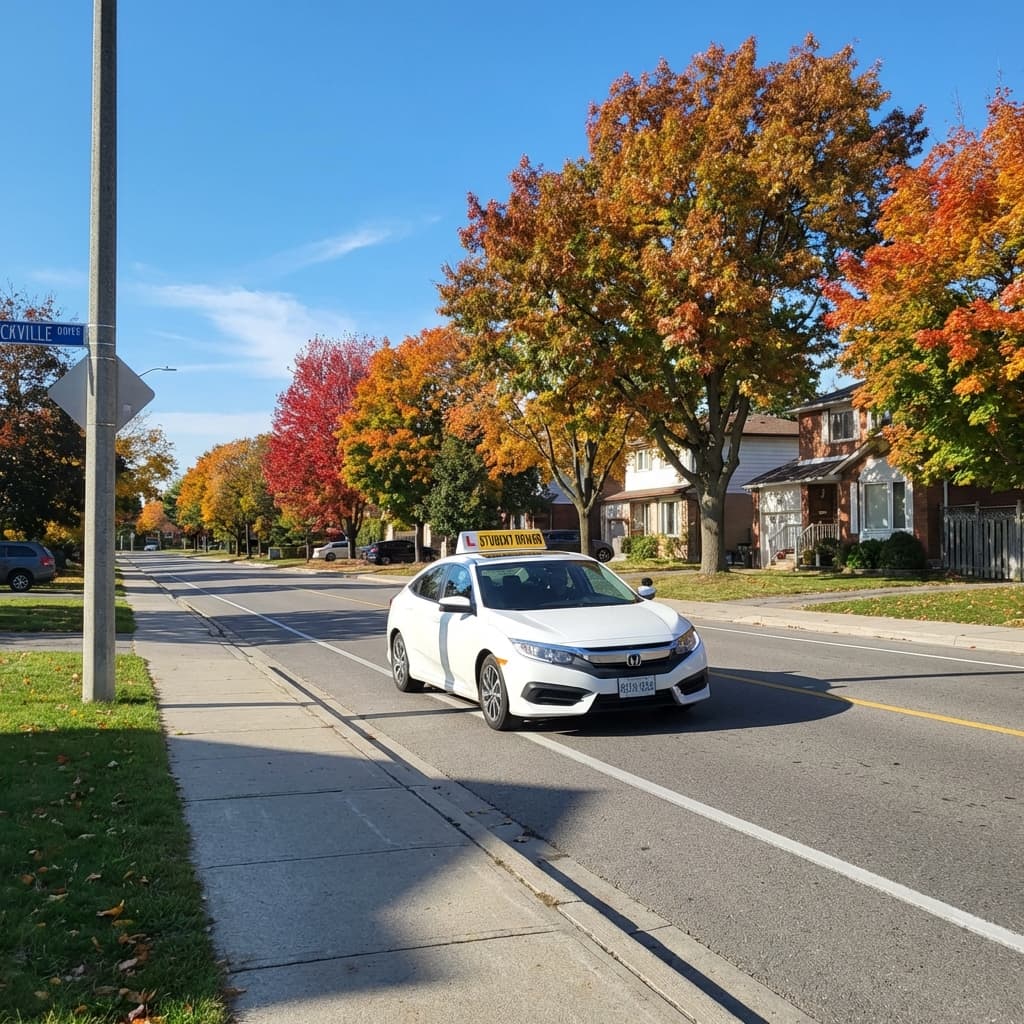
Taking your road test in Lower Sackville? You've made a strategic choice. While every test route varies slightly, the Sackville area offers a predictable mix of residential and commercial driving that many students find manageable.
However, "manageable" doesn't mean "easy." The Sackville test has its own unique challenges, from the busy multi-lane Sackville Drive to the specific highway merge points.
In this guide, we'll walk you through a typical Sackville road test profile—from the moment you leave the Access Nova Scotia parking lot to your final park.
1. The Start: Parking Lot & Departure
The test begins before you even move the car. The examiner will check your vehicle:
- brake lights
- signal lights (front and back)
- horn
- hand signals
The First Trap: Leaving the Lot When you leave the Access Nova Scotia parking lot on Beaver Bank Road, treat every end-of-row as a stop sign.
- Stop completely.
- Look left, look right.
- Shoulder check.
- Proceed.
Many regular drivers roll through these "parking lot intersections." Do not do this on your test. Also, watch out for the one-way driveway sections—entering the wrong way is an automatic fail.
2. City & Residential Driving
Once you exit onto Beaver Bank Road, you'll likely head towards Sackville Drive or into the nearby residential networks (like Stokil Drive or Pine Hill).
The Residential Zones (e.g., Stokil, Pine Hill, Prince St)
- Speed Control: The limit is 50 km/h unless posted otherwise. In these areas, stick to 45-50 km/h. Driving 35 km/h for no reason is considered "impeding traffic" and will lose you points.
- School Zones: Sackville has many. If children are present (outside, on the sidewalk, or in the yard), you must slow to 30 km/h. This applies 24/7/365 if kids are present.
- Intersections: residential intersections here can be tricky. Some have yield signs, some have stop signs, some are uncontrolled. Scan every intersection before entering.
The Sackville Drive Challenge
Sackville Drive is the main commercial artery. It's busy, multi-lane, and full of distractions.
- Lane Choice: Generally, stick to the right lane unless passing or turning left.
- The "Center Turn Lane": You may be asked to turn left into a business. Use the center turning lane correctly—enter it fully, slow down, and wait for a gap. Do not block traffic in the travel lane while waiting to turn.
- Traffic Lights: Watch for "stale" green lights. If a light has been green for a long time, anticipate it turning yellow.
3. The Highway Segment (Hwy 101/102)
You will almost certainly be asked to merge onto a highway. In Sackville, this is usually Highway 101 or the connector to the 102.
The Golden Rule of Merging:
- Use the Ramp: The ramp is for acceleration. You need to be at (or very close to) 100 km/h before you merge.
- Don't Hesitate: Entering a 100 km/h highway at 70 km/h is dangerous and is a common reason for failure.
- The Maneuver: Signal early, check your mirrors, check your blind spot (shoulder check), and slide into the gap.
4. Required Maneuvers
Somewhere during the test (often back in a quieter residential area or the industrial park), you'll be asked to perform:
Curbside Parking
- Get within 15 cm of the curb.
- Uphill with Curb: Wheels turned LEFT (away from curb).
- Downhill (or Uphill without Curb): Wheels turned RIGHT (towards curb).
- Tip: Always set your parking brake.
Reverse Parking
This usually happens at the very end, back at Access Nova Scotia.
- Take your time. It's not a race.
- 360 Check: Before you start backing up, look all around you.
- Use your mirrors.
- Back in slow.
- The Camera: You can glance at your backup camera, but do NOT stare at it. Your primary focus must be your mirrors and looking out the back window.
5. Summary of Critical Habits
Throughout the entire 20-30 minute drive, the examiner is watching for these "Global Skills":
- Shoulder Checks: Every. Single. Time. Lane change? Shoulder check. Turning right? Shoulder check (for cyclists). Pulling over? Shoulder check.
- Scanning: Keep your eyes moving. Don't stare at the bumper in front of you. Check your rearview mirror every 5-8 seconds.
- Smoothness: Brake gradually. Accelerate steadily. Jerky driving suggests nervousness or lack of control.
- Confidence: If you have the right of way, take it. Hesitating when it's your turn confuses other drivers and can be dangerous.
Ready to Practice? Knowing the route is one thing; driving it is another. Our instructors take students on these exact loops every day.
First Lake Sackville Driving Academy
Professional Driving Instruction