Nova Scotia Road Signs: Complete Study Guide for Your Driving Test
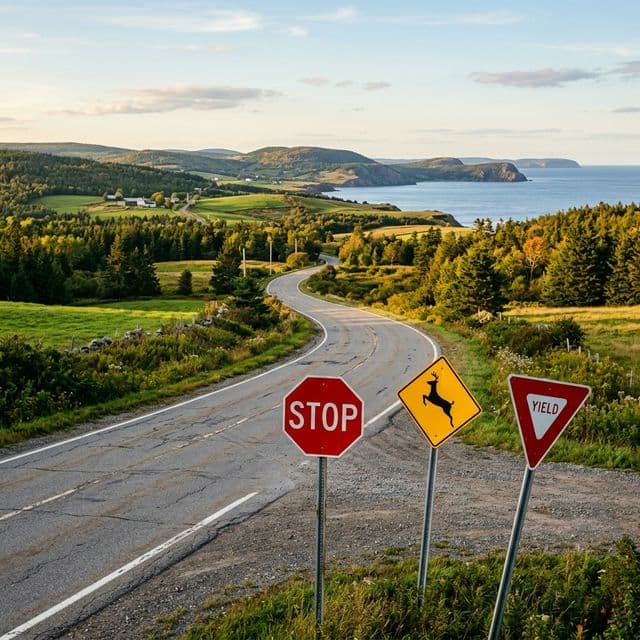
Road sign questions are the #1 reason people fail the Nova Scotia knowledge test. Not speed limits. Not right-of-way rules. Road signs — because there are dozens of them, they all look similar if you don't know the system, and one wrong answer can be the difference between passing and rebooking.
This guide covers every sign category you'll see on the test: regulatory, warning, information, and traffic signals. You'll also get the most common mistakes test takers make and a practical memorization strategy that actually works.
Once you've reviewed this guide, test your road sign knowledge with our free practice quiz.
How Road Signs Work in Nova Scotia
All Canadian road signs follow a consistent shape and color system based on national standards. This is good news: once you know the system, every sign tells you something before you even read the text.
Shape tells you the type of sign:
- Octagon = Stop
- Triangle (pointing down) = Yield
- Diamond = Warning
- Rectangle = Regulatory or information
- Pentagon = School zone / school crossing
- Circle = Railway crossing (advance warning)
Color reinforces meaning:
- Red = prohibition or stop
- Yellow = warning
- Green = directional or information
- Blue = services
- Orange = construction or temporary
- Brown = recreational or cultural sites
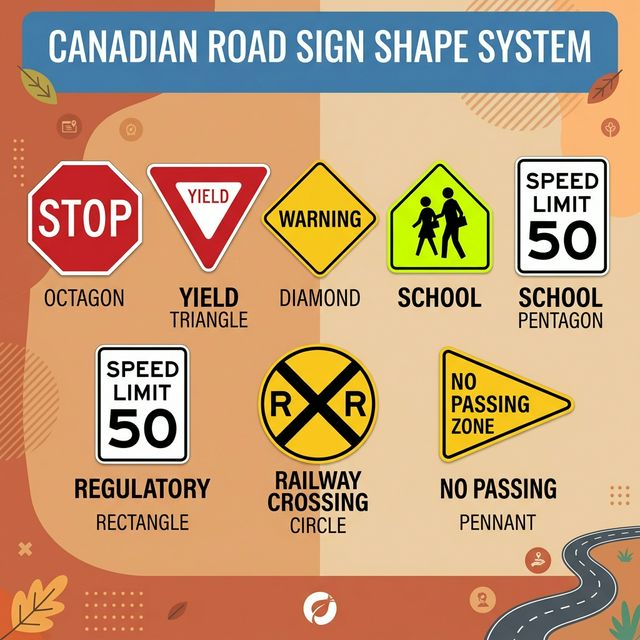
Memorize the shape-color system first. Once you have it, even an unfamiliar sign tells you 80% of what you need to know.
Regulatory Signs (What You MUST Do)
Regulatory signs tell you what the law requires. Ignoring them isn't just a test mistake — in real life, it means a ticket and demerit points.
Stop sign (red octagon): Full stop required at the stop line. If there's no line, stop before the crosswalk. If there's no crosswalk, stop before the intersection. "Close enough" is not a complete stop.
Yield sign (red and white triangle): Slow down and be prepared to stop. Give right of way to traffic on the through road. You only stop if you actually have to — yielding when no one's there is not required.
Speed limit signs (white rectangle, black numbers): The posted number is the maximum in km/h. Not a target. Not a suggestion. The maximum.
No entry / Do not enter (red circle with white bar): Wrong-way street ahead. This is an immediate hazard. Turn around.
One way (rectangle with arrow): Traffic moves in the arrow direction only. Check this before turning.
No parking (red circle with crossed P): Different from "no stopping." No parking means you can't leave an unattended vehicle there. Stopping briefly to drop someone off may still be allowed.
No passing: In Nova Scotia, no-passing zones are marked by the solid yellow centre line on the pavement, not by a special sign. A solid line on your side means passing is unsafe. (The pennant-shaped "no passing zone" sign used in the United States is not used in Canada.)
Turn restrictions (red circle with crossed turn arrow): No left turn, no right turn, or no U-turn at this specific intersection.
School zone signs (pentagon shape, fluorescent yellow-green): The reduced limit applies when children are present, whatever the time of day. In Nova Scotia it's 30 km/h where the surrounding limit is 50 km/h, and 50 km/h where the surrounding limit is higher than 50. The pentagon shape is your first clue — even before you read the text.
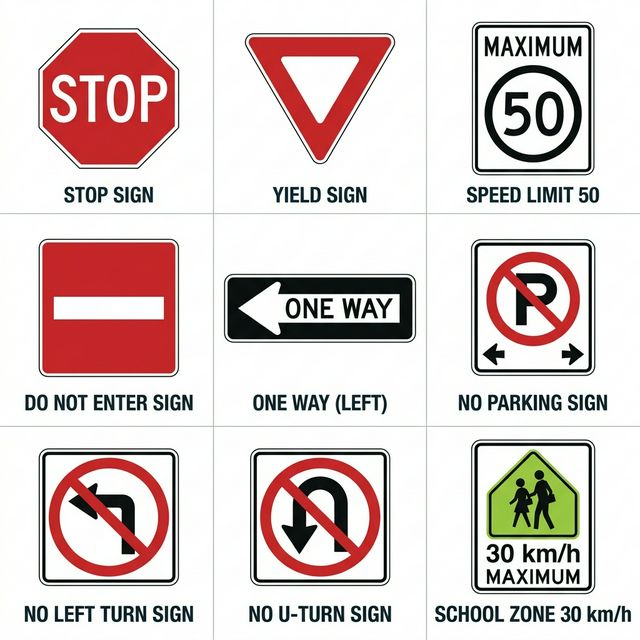
Test tip: Watch for questions that show a sign in context. The surroundings — an intersection, a crosswalk, a school nearby — often determine the correct answer, not just the sign itself.
Warning Signs (What to Watch For)
Warning signs alert you to hazards or changes ahead. They're informational, not legally enforced like regulatory signs — but ignoring them on the road is how people get into accidents.
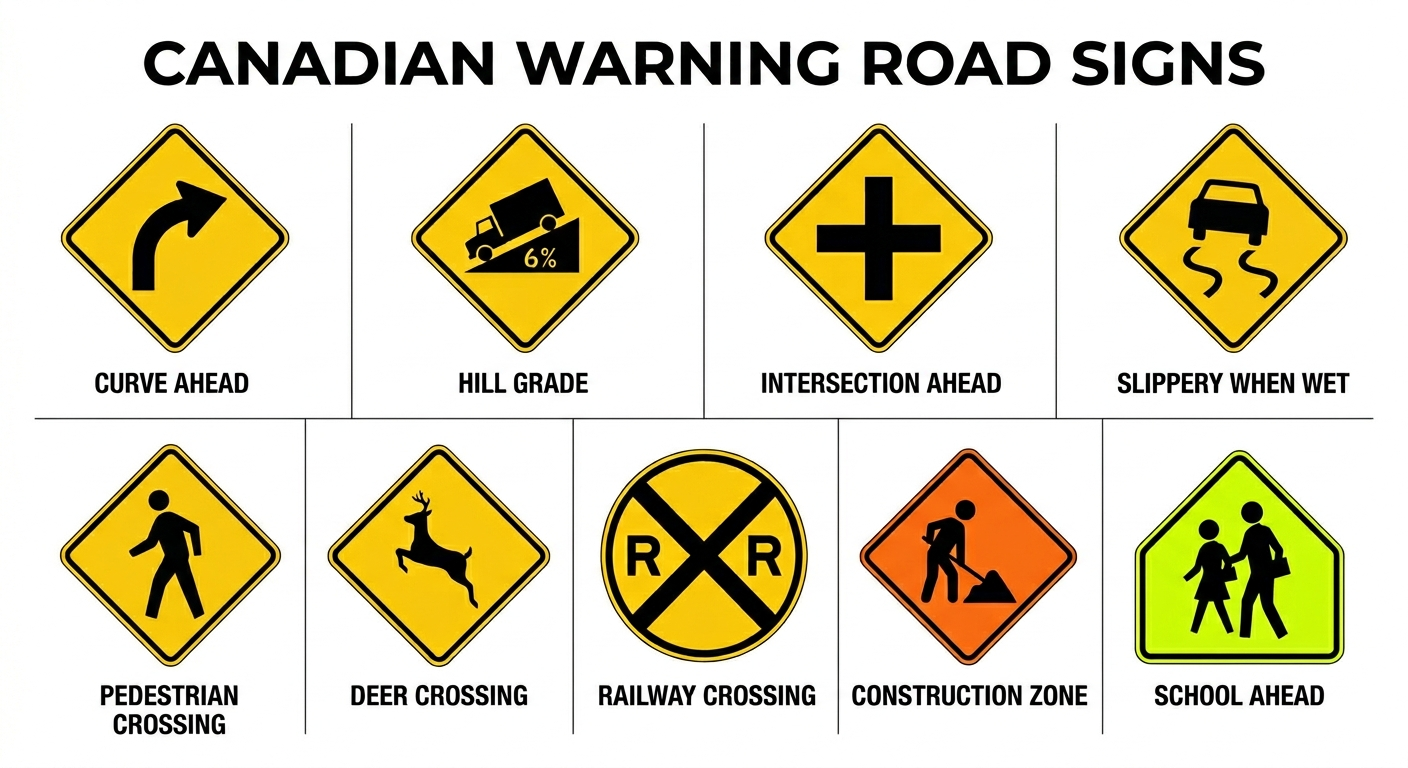
Curve ahead / Sharp curve (yellow diamond with arrow): Tells you the road bends. The tighter the bend in the arrow, the sharper the curve.
Hill / Steep grade (yellow diamond): Shows a percentage grade for trucks, but it signals that your brake distance will change significantly on the descent.
Intersection ahead (yellow diamond with cross or T): A cross means a four-way intersection is coming; a T means a T-intersection.
Pedestrian crossing (yellow with walking figure): Watch for people crossing.
Deer crossing / Wildlife (yellow diamond with deer silhouette): Very common in Nova Scotia. These aren't decorative — there are real deer at these locations.
Slippery when wet (yellow diamond with car and skid marks): The road surface becomes dangerous in rain. Reduce your speed.
Railway crossing (yellow-and-black circle with an X): The only round warning sign. The Canadian version shows the X with the tracks angled to match how the rails actually cross the road — it does not have the "RXR" lettering used on the American sign. People often mistake the round shape for a regulatory sign. It's not — it's a warning that a railway crossing is ahead.
Construction zone (orange diamond): Temporary hazard ahead. Speed limits in construction zones are enforceable even if workers aren't present.
School ahead (yellow pentagon): Pentagon-shaped, which signals a school zone is coming before you see the actual zone sign.
Falling rocks: Common on Highway 103 along the South Shore. Slow down and watch for debris on the road.
Nova Scotia tip: Wildlife signs are common in rural NS. Deer and moose are real hazards, especially at dawn and dusk. Slow down when you see one — it's not a suggestion.
Information & Guide Signs (Where You're Going)
Information signs help you navigate. They aren't a major focus on the knowledge test, but you should recognize the color-coded categories.
Highway route markers: Different shapes for 100-series highways vs. provincial routes vs. trunk routes. The shield shape varies by road class.
Distance and direction signs (green): Show distances to upcoming towns, exits, or intersections.
Service signs (blue): Gas stations, food, lodging, hospitals, phone. Blue always means services ahead.
Tourism signs (brown): Provincial parks, historic sites, beaches, and cultural attractions. Brown with white text.
Exit signs (green with white): Numbered exits with destination names. In Nova Scotia, exit numbers correspond to the kilometer marker on the highway.
Note: Information signs aren't a major focus on the test, but you should be able to identify the color-coded categories and know what each color means at a glance.
Free Interactive Practice Quiz
Test yourself with real exam-style questions
No sign-up required to start. Get detailed results after completing the quiz.
Traffic Signals — The Section That Trips People Up
Flashing signal questions appear on almost every Nova Scotia knowledge test. And they fail people — frequently. Here's everything you need to know.
Solid lights (the straightforward ones):
- Solid green: Proceed if it's safe — other vehicles may also be moving
- Solid yellow: Prepare to stop. Only proceed if you physically cannot stop safely
- Solid red: Full stop. Wait for green before proceeding
Flashing lights (this is where people fail):
- Flashing red: Treat it exactly like a stop sign — come to a complete stop, check for traffic, then proceed when it's safe
- Flashing yellow: Caution. Slow down and be alert, but you don't stop unless you need to
- Flashing green (advance green): Oncoming traffic is stopped at a red light, so you have a protected movement — you may turn left, go straight, or turn right. Because the left turn is the reason it exists, most people call it a "protected left turn." This one trips up almost every test taker. Do not confuse it with a regular solid green.
Arrow signals:
- Green arrow: Protected turn in the arrow direction — oncoming traffic is stopped
- Yellow arrow: Your protected turn is ending — prepare to stop
- Red arrow: No turn in that direction
Pedestrian signals:
- Walking person (white): Cross now
- Raised hand (orange): Don't start crossing
- Flashing hand with countdown: If you've already started crossing, finish. If you haven't started, wait.
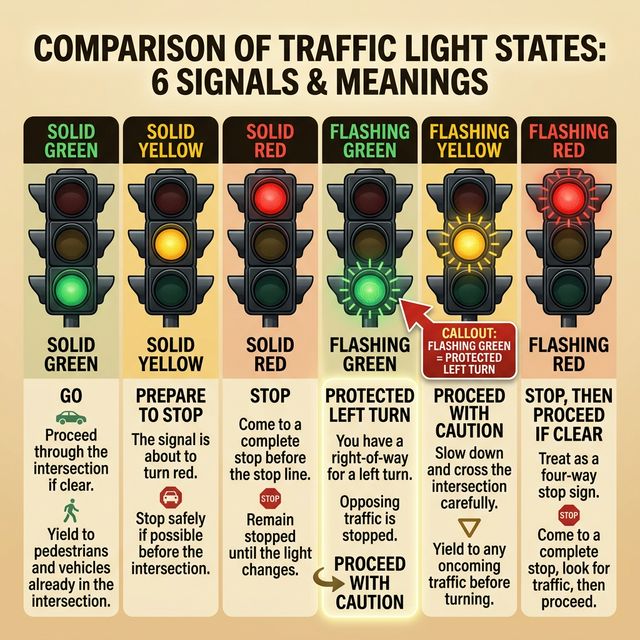
If you remember nothing else from this section: flashing green = protected left turn. This single question fails more first-time test takers than anything else.
5 Common Sign Mistakes That Fail Test Takers
-
Confusing flashing green with solid green. Flashing green means you have a protected left turn — oncoming traffic is stopped. Solid green means standard right of way — oncoming traffic may also be moving. They are not the same situation.
-
Treating yield like stop. Yield means slow down and give way. You only stop if there's actually traffic. Stopping at a yield sign when no one's there isn't required — and on a driving test, unnecessary stops can be marked against you.
-
Missing the school zone shape. Pentagon-shaped, fluorescent yellow-green signs mark school zones. The 30 km/h limit applies whenever children are present — not just during school hours, not just on weekdays.
-
Confusing construction signs with regulatory signs. Orange signals temporary conditions, yellow and red signal permanent regulatory rules. A 50 km/h orange construction zone sign is legally enforceable while construction is active.
-
Not knowing the railway crossing sign is round. The round yellow X-bordered sign is the only round warning sign in Canada. Most other warning signs are diamond-shaped, so the circular shape catches people off guard. Don't confuse it with a regulatory sign — it's purely a warning that a railway crossing is ahead.
How to Memorize Road Signs Fast
-
Group by shape and color first. Once you know "octagon = stop, triangle = yield, diamond = warning," you can identify the sign category before reading any text. Build the framework, then fill in the details.
-
Use spaced repetition. Don't cram. Study signs for 15 minutes a day for 4 to 5 days — it's far more effective than 2 hours the night before your test.
-
Take practice tests with sign questions. Active recall beats passive flashcards every time. Take our free practice test repeatedly until you stop missing the same signs.
-
Review your mistakes. Every time you get a sign question wrong, note the category and shape. Patterns emerge quickly — most people mix up the same 2 or 3 sign types repeatedly. Once you spot the pattern, you can fix it.
Signs are only one slice of the test. If you are starting from zero, our Access Nova Scotia approved driver's education course covers the whole handbook alongside in-car training, and it shortens the learner period from 12 months to 9.
Want to Get Sign Questions Right Every Time?
If you're still mixing up the same handful of signs after studying this guide, an instructor can fix that in a single 60-minute Zoom session. We'll work through the signs you keep missing, explain the reasoning behind each answer, and run through real exam-style questions until you stop second-guessing yourself.
For a broader look at what's on the test — including road rules, right-of-way, and more — read our complete Nova Scotia practice test guide.
Frequently Asked Questions
How many road sign questions are on the Nova Scotia test?
There is no fixed number. The knowledge test is 20 questions in total, drawn at random from a large bank, and traffic signs and signals is the largest single category — so expect several.
What does a yellow diamond road sign mean?
Warning. In the Canadian system, shape tells you the sign type and colour tells you the urgency: a diamond is a warning, and yellow means a permanent hazard ahead such as a curve, an intersection, wildlife, or a slippery surface. Orange diamonds mean the same hazard, but temporary.
Which is the only round warning sign in Canada?
The railway crossing sign — a yellow-and-black circle with an X. The Canadian version angles the X to match how the rails actually cross the road and has no "RXR" lettering. Its round shape often gets mistaken for a regulatory sign.
Are road signs tested separately from the rest of the knowledge test?
No. Sign questions are mixed in with rules of the road, safe driving practices, GDL rules, and impairment law in the same 20-question test. There is no separate signs exam.
First Lake Sackville Driving Academy
Professional Driving Instruction