How to Prepare for Your Halifax Driving Test (2026 Guide)
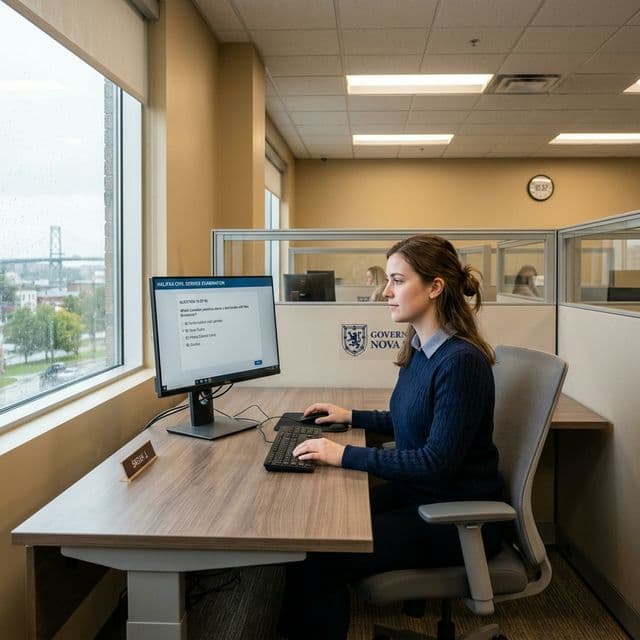
Booked your written driving test in Halifax? Here's exactly what to expect at the Access Nova Scotia office and how to prepare so you pass on your first try. The test itself is the same provincial exam offered at every Access NS location in Nova Scotia, but Halifax residents have specific office logistics, wait time patterns, and local quirks worth knowing before you show up. This guide covers all of it.
Where to Take the Written Test in Halifax
Halifax residents have three Access Nova Scotia offices to choose from. Pick strategically.
Halifax Access Nova Scotia (Bayers Lake) -- 300 Horseshoe Lake Drive, Bayers Lake Business Park, Halifax. This is the main Halifax location, convenient for residents of Clayton Park, Halifax Peninsula, and Fairview. It is one of the busier offices, so expect longer waits during midday and on Fridays. Best time to go: Monday through Wednesday, first thing in the morning at opening.
Dartmouth Access Nova Scotia -- 250 Baker Drive, Suite 134, Russell Lake West, Dartmouth. Many Halifax residents use this location because it is accessible from the bridge and often has shorter lines than the Halifax office. If you live anywhere near Dartmouth or use the Macdonald Bridge regularly, this is a smart choice. Early morning mid-week is your best bet here too.
Sackville Access Nova Scotia -- 486 Sackville Drive, Lower Sackville. For Halifax residents who prefer less traffic and are willing to make the drive north, Sackville is routinely the quietest option. Take our free practice test first so you are ready, then head to Sackville, walk in, and be done in 30 minutes.
If your local Halifax office has long waits, the Sackville office is often a faster option -- same test, same provincial system.
What to Bring to Your Test
Show up prepared and you will spend zero time scrambling at the front desk.
- Valid ID -- birth certificate, passport, or PR card (your health card is not accepted as primary ID)
- Proof of Nova Scotia residency -- utility bill, lease agreement, or bank statement showing your current Halifax address
- Glasses or contact lenses if you wear them -- you may be asked to pass a quick vision check on-site
- Payment for the testing fee -- debit and credit are accepted; check the current fee at the Access Nova Scotia website before you go
- Parent or guardian -- required if you are under 18; they must be present in the office
One tip: do not bring your phone into the testing room. It is not allowed and will be left at the front desk.
What's Actually on the Halifax Driving Test
The written knowledge test is computer-based, 20 multiple-choice questions, and you need to get 16 correct (80%) to pass. There is no strict time limit -- most people finish in 15 to 20 minutes. Your result appears on screen the moment you submit.
The questions fall into these categories:
- Road signs and signals -- regulatory signs (red and white), warning signs (yellow diamond), information signs (green or blue)
- Rules of the road -- right-of-way, speed limits, passing, merging
- Safe driving practices -- following distance, adverse weather driving, visibility
- Graduated Driver License (GDL) program rules -- restrictions on Class 7 learners and Class 5N new drivers
- Alcohol and drug impairment laws -- zero tolerance for new drivers, blood alcohol laws for full license holders
The test is not Halifax-specific -- it is the same Nova Scotia knowledge test administered at every Access NS office. But knowing what is on it helps you focus your study time.
Free Interactive Practice Quiz
Test yourself with real exam-style questions
No sign-up required to start. Get detailed results after completing the quiz.
How to Study Effectively
Follow these four steps in order.
-
Read the Nova Scotia Driver's Handbook cover to cover. The Nova Scotia Driver's Handbook is the source material for every question on the test. Do not skim it. Actually read it, especially the sections on signs, right-of-way, and GDL rules.
-
Take practice tests repeatedly. Reading is passive. Testing yourself builds the active recall that makes answers come instantly under pressure. Take our free Nova Scotia practice test -- each session gives you 10 random questions drawn from a bank that covers every topic on the real exam.
-
Focus on road signs. Sign questions are the number one reason people fail. Learn signs by shape and color first: octagon means stop, downward triangle means yield, yellow diamond means warning. Then memorize specific signs within each category. Our Nova Scotia Road Signs Study Guide breaks every sign down by shape and color -- work through it.
-
Memorize the key numbers. These show up on almost every test:
- School zone speed: 30 km/h
- Default highway speed when no signs are posted: 80 km/h
- Minimum following distance: 2 seconds
- Accident reporting threshold: $2,000 in damage
Common Reasons People Fail in Halifax
If you know the failure points in advance, you can study around them.
- Confusing flashing traffic signals -- flashing red means full stop (treat it as a stop sign); flashing yellow means caution, slow down; flashing green means you have a protected left turn and right of way
- Not knowing right-of-way at uncontrolled intersections -- yield to the vehicle already in the intersection or to the vehicle on your right when you arrive simultaneously
- Underestimating school zone rules -- 30 km/h applies whenever children are present near the road, regardless of time of day or whether school is in session
- Rushing through questions -- there is no time pressure, so read each question completely before selecting an answer
- Skipping the "all of the above" check -- when "all of the above" is an option, verify each individual answer before selecting it; test writers love this trap
After You Pass: Your Halifax Road Map
Pass the written test and you receive your Class 7 Learner's License on the spot. From there:
- You must hold the Class 7 for at least 12 months before you can book your road test, or just 9 months if you complete a government-approved BDE course
- During the learner period, you must drive with a licensed supervisor (Class 5 or higher, with 2 or more years of experience)
- Zero alcohol tolerance applies -- any amount of alcohol in your system while driving is a violation
- When you are ready for the road test, our in-car lessons cover the specific skills examiners evaluate
- The road test itself is booked through Access Nova Scotia — see our road test booking guide for the steps and the documents you need on the day
Still Not Sure You're Ready?
If you've taken the practice test a few times and you're still missing the same kinds of questions, a focused 1-on-1 session with an instructor will move the needle faster than another round of self-study. We'll go through your weak areas, walk through real exam-style questions, and make sure you walk into Access Nova Scotia confident.
First Lake Sackville Driving Academy
Professional Driving Instruction